_edited.png)
SUMMER SKINCARE ROUTINE: EXPERT TIPS TO PROTECT YOUR SKIN FROM SUN DAMAGE AND PIGMENTATION
Updated: Aug 22
At a Glance: Summer Skincare Essentials
In this month's journal, we explore:
Why a high-quality, broad-spectrum SPF is an essential part of your daily summer skincare ritual.
Why hydration still matters when skin feels oily and how to choose a lightweight formula that suits your skin.
Simple ways to support and protect your skin barrier throughout the summer months.
How to help prevent pigmentation before it appears, rather than treating it once it has developed.
How to choose skincare that is truly suited to your skin type and individual needs.
Why, when it comes to skincare, a considered and consistent routine often delivers more than an elaborate one.

Summer is often the season when we become most aware of our skin. Longer days, warmer weather and holidays abroad mean more time outdoors, and most of us want our skin to look healthy, radiant and glowing in return. Yet the same season that brings out your skin's natural luminosity also brings some of its greatest challenges. Increased UV exposure, heat, humidity, sweat and environmental stress all change the way your skin behaves, and for some patients this shows up as pigmentation, while for others it means congestion, dehydration or breakouts.
One of the questions I'm asked most often in clinic is whether patients need to change their skincare routine for summer. The answer is yes, though probably not in the way you'd expect. Rather than adding in new products or chasing the latest trend, I usually encourage patients to simplify their routine and focus on three things: protecting the skin barrier, preventing unnecessary inflammation and supporting the skin's long term health. Understanding why your skin behaves differently in summer is the first step, so let's start there before looking at how oily, dry and pigmentation prone skin each need a slightly different approach.
Why Does Your Skin Change in Summer?
Skin is constantly adapting to the environment around it, and during summer several factors act on it at once: rising temperatures, humidity, UV exposure and perspiration, along with less obvious influences such as swimming pools, sea water, air conditioning and long haul flights. Heat stimulates the sebaceous glands, so your skin often produces more oil than usual, while increased water loss through sweating and prolonged sun exposure can leave it dehydrated at the same time. This is why skin can feel oily and tight within the very same day.
Ultraviolet radiation adds a further layer of stress, generating oxidative damage that contributes to collagen breakdown, uneven pigmentation and many of the visible signs of premature ageing1. These changes aren't always obvious straight away, which is exactly why a considered approach to summer skincare matters, whatever your skin type. Oily, dry and pigmentation prone skin each respond to summer in their own way, so it helps to understand your own skin before adjusting your routine.
Summer Skincare Routine for Oily Skin

If your skin becomes noticeably shinier in summer, heat is usually the main driver. Warmer temperatures stimulate the sebaceous glands, prompting them to produce more oil to help regulate the skin. At the same time, sunshine, sea water, chlorine and air conditioning can all reduce the water content of the skin. When skin becomes dehydrated, it often responds by producing even more oil to compensate, creating a frustrating cycle of shine, congestion and breakouts2. It's a distinction I explain often in clinic: oily skin and hydrated skin are two very different things, and one doesn't rule out the other.
The instinct with oily skin is usually to strip the routine back, reaching for harsher cleansers or skipping moisturiser altogether. In my experience this tends to make things worse, not better. Oily skin still needs moisture, just in a lightweight, non comedogenic form that replenishes hydration without adding heaviness. Focus on a gentle cleanser that removes sweat, oil and sunscreen without disrupting the skin barrier, followed by a hydrating serum and a light moisturiser if your skin needs it. Healthy skin isn't about removing every trace of oil, it's about restoring balance so your skin can regulate itself properly, and that starts with hydration rather than harsher cleansing.
“One of the biggest misconceptions I encounter is that oily skin can't be dehydrated. In reality, oil production and skin hydration are entirely separate aspects of skin health. Preserving the skin barrier with a gentle, balanced routine is often far more effective than trying to strip oil away” Dr Emily, Medical Director of Dr Emily Aesthetics and Rejuvenation
Summer Skincare Routine for Dry Skin
Dehydration doesn't always look the way you'd expect, and some of the driest skin I see in clinic during summer doesn't feel oily at all, it feels tight, dull or flaky. Flights, air conditioning, warmer temperatures, sea water and chlorine can all disrupt the skin barrier and accelerate water loss, even on days when you haven't spent long in the sun. Once the barrier is compromised, skin struggles to hold onto moisture, which is why dryness can seem to appear quite suddenly during the summer months.
For dry or dehydrated skin, the priority is barrier support rather than active ingredients. A hydrating serum that helps replenish water within the skin, followed by a richer moisturiser in the evening, makes a meaningful difference. For patients with persistent dehydration, our skin booster treatments can complement a medical-grade skincare routine by delivering hydration directly into the skin at depths that topical skincare alone cannot reach. Used together, these treatments provide a comprehensive approach to improving skin hydration and enhancing overall skin quality. I'd also encourage avoiding over cleansing or exfoliating too frequently, since both can further compromise an already fragile barrier. Consistency matters more than complexity here. A simple routine you follow every day will almost always outperform an elaborate one you struggle to maintain.
Summer Skincare Routine for Pigmentation Prone Skin

Pigmentation is one of the most common concerns I treat during the summer months, particularly in patients with melasma or a history of post inflammatory pigmentation following acne or skin irritation. Most people know that UV radiation contributes to pigmentation, but heat itself can also stimulate pigment producing cells, which means pigmentation can become more noticeable even without direct, prolonged sun exposure3. Inflammation plays a role too. Over exfoliation, picking at blemishes or using products that compromise the skin barrier all increase the likelihood of pigmentation developing as the skin heals.
Daily broad spectrum sunscreen is the single most important step for pigmentation prone skin, and this applies every day, not only on holiday4. UVA rays penetrate cloud cover and are present throughout the year, which is why I encourage patients to treat sunscreen as a daily habit rather than a holiday one. An antioxidant serum each morning offers a further layer of defence by neutralising free radicals generated by UV exposure and pollution, working alongside your sunscreen rather than replacing it.
However, sunscreen alone isn't always enough for skin that's already prone to pigmentation. Sunscreen stops new pigment from forming by blocking UV rays, but it doesn't do much to calm down pigment production that's already switched on, and in summer, heat alone can switch it on even without any sun exposure. This is why I consider a pigment suppressor an essential part of the routine for pigmentation prone skin, rather than a nice to have.
In plain terms, a pigment suppressor works by calming the skin's pigment producing process itself, rather than simply shielding the skin from future damage. Some ingredients quieten the process that creates pigment in the first place, others stop that pigment reaching the surface of the skin, and others simply calm the irritation that tends to set the whole thing off. Studies combining these types of ingredients have shown a noticeably better result than sunscreen alone5. Used together, sunscreen and a pigment suppressor cover both sides of the problem, sunscreen keeps new triggers away from your skin, and a pigment suppressor calms your skin's tendency to overreact to the triggers you can't always avoid, whether that's heat, hormones or everyday irritation. I'll share the specific product I rely on for this a little further on. Beyond product choice, the most protective habit is simply avoiding unnecessary irritation to the skin.
“Protecting pigmentation prone skin consistently is always far easier than trying to correct it once it has developed.” Dr Emily, Medical Director of Dr Emily Aesthetics and Rejuvenation
Building Your Daily Summer Skincare Routine
Whatever your skin type, the structure of a good summer routine stays largely the same, it's the individual products within each step that should reflect your own skin's needs.

Morning
Begin with a gentle cleanse to remove overnight oil without disrupting the skin barrier, then apply an antioxidant serum to help defend against environmental damage. Follow with a moisturiser suited to your skin type where needed, and finish with a broad spectrum sunscreen. This final step matters most: applying sunscreen each morning should become as routine as brushing your teeth, whether you're at the beach or working indoors.
Evening
Your evening routine is the opportunity to remove sunscreen, makeup, sweat and pollution before supporting your skin's natural overnight repair. If you've worn makeup or sunscreen during the day, double cleansing helps ensure everything is properly removed. After cleansing, focus on hydration and barrier support rather than introducing several new active ingredients at once.
Dr Emily's Summer Skincare Edit
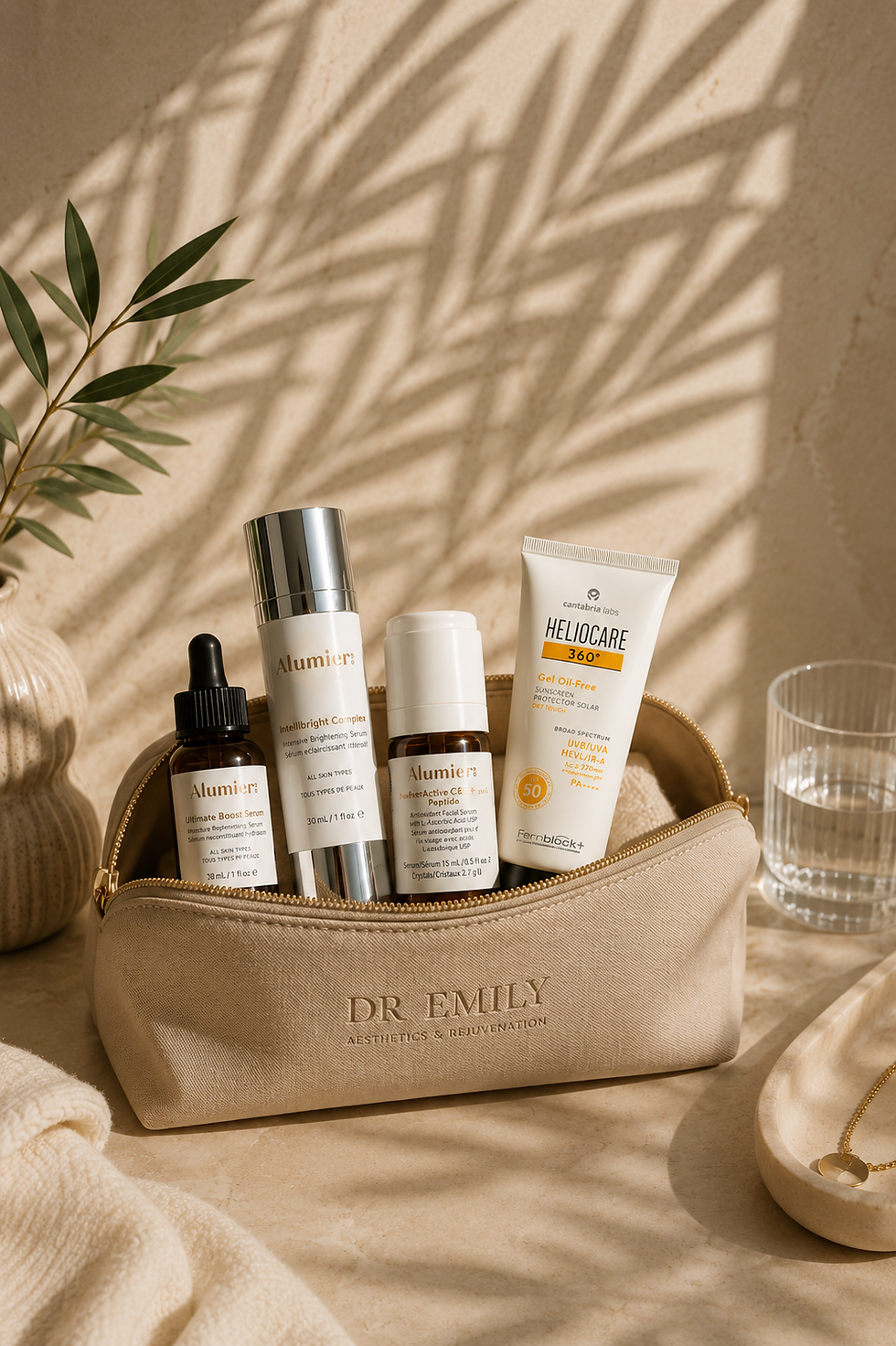
I'm often asked whether my own skincare changes when I travel, and the answer is yes, though not in the way people expect. Rather than packing more products, I actually simplify my routine, since travel is rarely the time to experiment with new formulations or overwhelm the skin with multiple activities. These four products earn a place in my bag every summer.
AlumierMD EverActive C&E + Peptide
Vitamin C remains one of the most researched ingredients in skincare, helping brighten the complexion while acting as a powerful antioxidant against UV and pollution induced free radicals. I like this formulation in particular because it combines Vitamin C with Vitamin E and peptides to support collagen production, and the individual packaging keeps the vitamin C stable and effective. It works alongside sunscreen, never in place of it.
AlumierMD Ultimate Boost Serum
As explained above, dehydrated skin doesn't always feel dry, and some of the oiliest skin I see in summer is actually lacking water. This serum helps replenish hydration and support the barrier, which is why it's a staple throughout the warmer months, particularly for travel.
AlumierMD Intellibrite
This one is personal. I'm prone to pigmentation myself, particularly after time in the sun or heat, so it's never left out of my suitcase on summer holidays. Intellibrite works as a pigment suppressor, calming the skin's pigment producing activity rather than only protecting against future damage, which makes it especially useful over summer, when both heat and sun exposure are often working against pigmentation prone skin at the same time. I introduce it early in the season, before pigmentation has the chance to become more established, and I always use it alongside daily sunscreen rather than in place of it.
HelioCare 360O Gel Oil-Free SPF50
If I could recommend only one product for summer, it would always be sunscreen, and this is the formula I reach for most often across my patients, whatever their skin type. It's lightweight and non comedogenic, so it won't clog pores or add to congestion, even on oilier or blemish prone skin. It also carries a subtle tint, which helps it sit more naturally on the skin and avoids the white, chalky cast that heavier mineral formulas can leave behind, something a lot of patients tell me puts them off wearing sunscreen consistently in the first place.
“A sunscreen you actually enjoy wearing is the one you'll wear every single day, and that consistency is what protects your skin.” Dr Emily, Medical Director of Dr Emily Aesthetics and Rejuvenation
Common Summer Skincare Mistakes to Avoid

Here are the most common mistakes I see:
Wearing sunscreen only while on holiday, rather than every day
Stopping moisturiser because the skin feels oily
Over exfoliating in an attempt to control shine
Introducing several new products just before travelling
Forgetting to reapply sunscreen after swimming or long periods outdoors
Waiting until pigmentation appears before introducing a pigment-suppressing skincare product
Small, consistent habits will almost always do more for your skin than dramatic changes to your routine. Summer is also a natural point to review your skincare and check it's still meeting your skin's needs, whether that's adjusting for oiliness, dryness or pigmentation. Summer skincare isn't about chasing perfection, it's about understanding how your skin responds to the warmer months, making thoughtful adjustments and protecting it from preventable damage. With the right combination of daily sun protection, hydration and evidence based skincare, you can support your skin's health well beyond the summer months.
If you're unsure whether your current routine is right for your skin, or you'd like personalised advice on pigmentation, dehydration, skin quality or overall rejuvenation, I'd be delighted to discuss your goals during a consultation. Whether that's refining your skincare routine or exploring treatments such as SkinPen Microneedling or Skin Boosters, we'll create a personalised plan tailored to your skin.
Reviewed by Dr Emily Strong
Dr Emily has nearly two decades of experience in aesthetic medicine and specialises in natural-looking facial rejuvenation, skin health and bespoke treatment planning.
Further Reading & Clinical Resources
Krutmann J, Schalka S, Watson REB, Wei L, Morita A. Daily photoprotection to prevent photoaging. Photodermatol Photoimmunol Photomed. 2021;37(6):482-489.
Li D, Zhou Z, Yang X, et al. A comprehensive review: the bidirectional role of sebum in skin health. Bioengineering. 2025;12(12):1333.
Zhang L, Zeng H, Jiang L, et al. Heat promotes melanogenesis by increasing the paracrine effects in keratinocytes via the TRPV3/Ca2+/Hh signaling pathway. iScience. 2023;26(5):106749.
Passeron T, et al. "Photoprotection According to Skin Phototype and Dermatoses: Practical Recommendations From an Expert Panel." Journal of the European Academy of Dermatology and Venereology. 2021;35(Suppl 1):3–19.
Lee DH, Oh IY, Koo KT, et al. Reduction in facial hyperpigmentation after treatment with a combination of topical niacinamide and tranexamic acid: a randomized, double-blind, vehicle-controlled trial. Skin Res Technol. 2014;20(2):208-212.


