_edited.png)
THE TRUTH ABOUT TANNING AND SKIN AGEING: WHAT'S REALLY HAPPENING BENEATH THE SURFACE
- Jul 1
- 5 min read
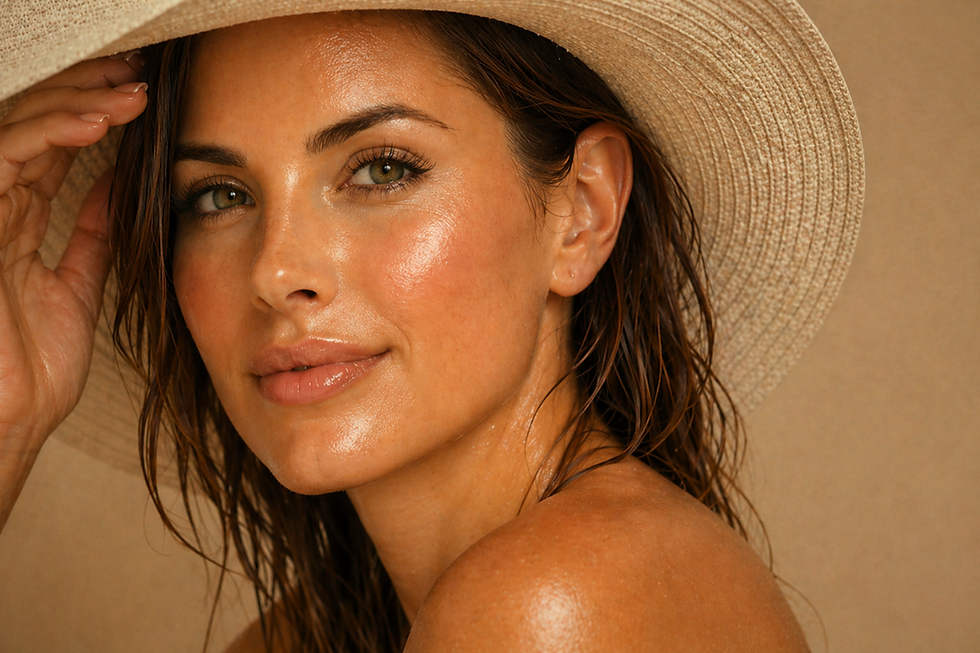
Holidays. Sunshine. A little colour. We’ve all been there. You come home feeling refreshed, your skin looks bronzed, and for a moment you feel healthier. Glowing, even. But there is something I talk to my patients about regularly that often comes as a real surprise: a tan is not actually a sign of healthy skin.
I’m not here to take the joy out of sunshine. I love the outdoors, and time outside is genuinely good for us. But understanding what UV exposure does beneath the surface is something I feel passionately about because the effects are often very different from what we see in the mirror.
“One of the most common things I hear from patients is that their skin ‘suddenly’ started to look older in their thirties or forties. But what I see tells a different story. The changes were happening quietly for years. That’s exactly why sun protection and early intervention matter so much.” — Dr Emily, Medical Director of Dr Emily Aesthetics and Rejuvenation

What Happens Inside Your Skin When It's Exposed to UV

When UV light hits your skin, it triggers the production of melanin, the pigment that creates a tan. Many people see this as a sign that their skin is healthy or strengthening itself. In reality, melanin is produced as a defence mechanism. Your skin is trying to protect itself from damage. That golden glow may look beautiful, but it is a signal that your skin has already been affected by the sun.
At the same time, UV radiation triggers an inflammatory response that releases harmful free radicals and activates enzymes that break down collagen and elastin, the proteins responsible for firm, youthful-looking skin.1
This process happens with every exposure, not just when you burn. Day after day, year after year, it adds up. Research shows that UV exposure is responsible for an estimated 80–90% of visible facial ageing2, far more than the natural passage of time alone.3
Put simply: there is no such thing as a ‘safe tan’ from UV exposure, whether from the sun or a sunbed. The good news is that you absolutely don’t have to give up looking glowing; today’s self-tanning products and professional spray tans can give stunning results without any UV exposure at all.
Recognising Sun-Damaged Skin
Sun damage can show up in many ways. Here are the signs I look for:
Dark spots, uneven pigmentation or patches of melasma
A rough or thickened skin texture
Fine lines and wrinkles appearing earlier or more deeply than expected
Loss of firmness along the jawline, cheeks and neck
A dull, tired-looking complexion
Persistent redness or broken veins

What This Means for Lines, Wrinkles and Skin Firmness
One of the most visible effects of repeated sun exposure is the development of fine lines, deeper wrinkles, and a loss of skin firmness, changes that many people put down simply to getting older.
In reality, a large part of this is driven by the breakdown of collagen and elastin over years and years of UV exposure. Think of collagen as the scaffolding that holds your skin up, and elastin as the spring that lets it snap back into place. When UV radiation activates those damaging enzymes we mentioned, this scaffolding gets slowly dismantled.
Protecting Your Skin: The Essentials
SPF 50, worn every single day, not just on holiday, is the most evidence-based anti-ageing step you can take. Research has shown that daily sunscreen use not only prevents further damage but may also allow some reversal of existing photodamage, allowing the skin to begin repairing itself over time.4 Staying in the shade between 11am and 3pm and wearing a hat on sunny days makes a real difference too.
“SPF is genuinely the single most powerful anti-ageing product available. Not a luxury serum, not a treatment — sunscreen. Every single morning, rain or shine. That’s where great skin starts." — Dr Emily, Medical Director of Dr Emily Aesthetics and Rejuvenation
The science on this is very clear, and it’s why I talk about sun protection at every single consultation.
Reversing Existing Sun Damage: How We Can Help
Prevention is the foundation but there is a great deal we can do to treat existing damage and restore the skin’s health and appearance. At Dr Emily Aesthetics & Rejuvenation, I offer a carefully selected range of treatments for exactly this:
SkinPen Microneedling — stimulates the skin’s own collagen and elastin production, improving texture, firmness and fine lines over a course of treatments.
Skin Boosters & Polynucleotides — injectable treatments that work deep within the skin to encourage repair, boost hydration and rebuild collagen at a cellular level.
Skin Peels — medical-grade peels that remove damaged surface skin and bring through fresh, healthier skin, with a noticeable improvement in pigmentation and tone.
"These treatments work with your skin’s own biology. We are not masking the problem, we’re genuinely helping the skin rebuild itself. Combined with the right home care, the results can be really transformative.” — Dr Emily, Medical Director of Dr Emily Aesthetics and Rejuvenation
Medical-Grade Skincare: Supporting Your Skin Every Day
In-clinic treatments work best when they are supported by the right skincare at home. This is something I feel very strongly about: what you put on your skin every day has a cumulative effect, just like sun exposure does. Medical-grade skincare contains active ingredients at concentrations that actually make a clinical difference, and the formulations are backed by real evidence.
For patients showing signs of sun-related pigmentation, I regularly recommend HelioCare Pigment Solution, a specialist, evidence-backed formulation that combines high-level sun protection with active ingredients that directly target uneven skin tone. It’s a product I use myself and recommend with confidence.
A strong daily routine for sun-damaged skin should also include a vitamin C serum to combat free radical damage, a retinoid to boost collagen and speed up cell renewal, and SPF 50 every morning without exception.
Ready to Give Your Skin the Care It Deserves?
Whether you’re concerned about existing sun damage, pigmentation, or simply want to take a proactive approach to long-term skin health, I would love to welcome you to the clinic.
Book your personalised skin consultation with me today and we’ll create a treatment plan built around your skin’s individual needs.
Because healthy, radiant skin is a long-term investment and it starts now.
Reviewed by Dr Emily Strong
Dr Emily has nearly two decades of experience in aesthetic medicine and specialises in natural-looking facial rejuvenation, skin health and bespoke treatment planning.
Further Reading & Clinical Resources
1. Fisher GJ, et al. Mechanisms of photoaging and chronological skin aging. Archives of Dermatology. 2002;138(11):1462–1470.
2. Flament F, Bazin R, Laquieze S, Rubert V, Simonpietri E, Piot B. Effect of the sun on visible clinical signs of ageing in Caucasian skin. Clinical, Cosmetic and Investigational Dermatology. 2013;6:221–232.
3. Rittié L, Fisher GJ. UV-light-induced signal cascades and skin aging. Ageing Research Reviews. 2002;1(4):705–720.
4. Randhawa M, Wang SQ, Leyden JJ, Cula GO, Pagnoni A, Southall MD. Daily Use of a Facial Broad Spectrum Sunscreen Over One-Year Significantly Improves Clinical Evaluation of Photoaging. Dermatologic Surgery. 2016;42(12):1354–1361.