_edited.png)
UNDERSTANDING THE UNDER-EYE: WHY IT AGES FIRST, AND WHAT REALLY WORKS
Throughout my experience as an aesthetic practitioner, I have come to recognise that few areas of the face prompt as many questions as the under-eye. Patients rarely come to clinic seeking to look different. More often, they describe a feeling. They feel well rested, healthy and confident, yet still find themselves looking tired in photographs. They notice shadows beneath the eyes, a loss of brightness, or feel that concealer no longer works quite as well as it once did.
Some will arrive having researched tear trough filler and convinced themselves they know the answer. Others simply know that something has changed. What surprises many people is how early these changes can begin, and how often the solution lies not in treating what they see, but in understanding what is causing it in the first place.
It is also why, after nearly two decades in aesthetic medicine, I turn away more tear trough filler enquiries than I treat. Not because the procedure lacks merit, but because for many patients, it was never going to be the right starting point.
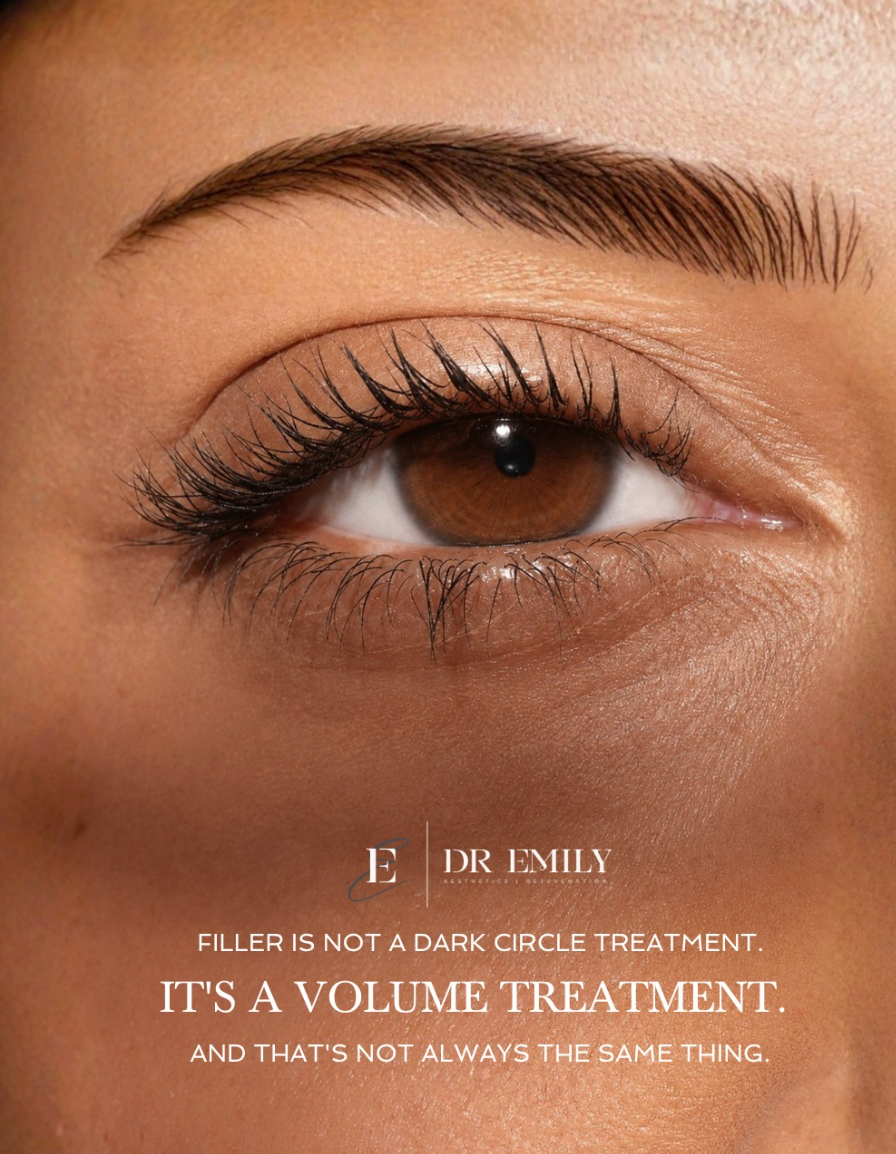
"Filler is not a dark circle treatment. It is a volume treatment. And those are not always the same thing. In my experience, this distinction is often overlooked, leaving many patients disappointed by the outcomes of previous under-eye treatments." — Dr Emily Strong, Medical Director of Dr Emily Aesthetics and Rejuvenation
Why Are The Eyes Often The First Area To Show Ageing?
The under-eye often begins to shows signs of age related changes long before the rest of the face, and there are several reasons why.
The skin around the eyes is the thinnest anywhere on the body and uniquely has an absence of supporting fat.1 Collagen and elastin, the proteins responsible for firmness and resilience, are also present at lower levels. At the same time, it is one of the most active areas of the face, moving constantly through blinking, smiling and everyday expression. Over time, this combination of thin skin, repeated movement and reduced structural support means the under-eye tends to show signs of ageing earlier than other areas.2
There is also a deeper structural change taking place beneath the surface. As we age, the bony framework around the eye gradually remodels, reducing some of the support beneath the surrounding tissues.3 This can contribute to hollowing, shadowing and a more tired appearance, even in patients whose lifestyle, weight and overall health have not changed.
For many patients, this is reassuring to hear. The changes they are noticing are not unusual or premature. They are simply one of the earliest and most recognised signs of facial ageing.
What Causes Dark Circles, Hollow Eyes And Under-Eye Shadows?
One of the most common misconceptions is that all under-eye concerns are the same. In reality, what patients describe as "dark circles" can stem from several completely different causes. These may include:
Volume loss creating hollowing and shadowing
Thin or translucent skin allowing underlying structures to show through
Pigmentation within the skin itself
Visible blood vessels creating a blue or purple appearance
Puffiness or under-eye bags caused by fat pad position and fluid retention

Two patients may present with almost identical concerns and require entirely different treatment plans. Treating both in the same way can lead to very different outcomes. This is why assessment always comes before treatment. At Dr Emily Aesthetics & Rejuvenation, understanding the cause is the most important step in creating a treatment plan that feels natural, balanced and appropriate for the individual.
Understanding The Right Treatment For The Right Cause
There is no single treatment that works for every under-eye concern. Successful treatment begins with understanding what is driving the issue and selecting the most appropriate approach.
Mid-Face Support: Looking Beyond The Under-Eye
The under-eye does not exist in isolation. As volume is lost through the mid-face, it can contribute significantly to the appearance of under-eye hollows.4 In many patients, restoring support to the cheeks improves the under-eye indirectly by recreating some of the structure that has been lost over time. For some patients, this is the most effective place to begin.
"This is often the explanation behind a question I hear frequently: why would filler placed in the cheek make any difference to the eyes? The answer is that the bony foundation supporting the mid-face and under-eye has quietly changed shape over time, and restoring some of that structure can recreate the support the area has gradually lost." — Dr Emily Strong, Medical Director of Dr Emily Aesthetics and Rejuvenation
Tear Trough Filler: When Volume Loss Is The Issue
For patients experiencing genuine volume loss beneath the eyes, tear trough filler can be highly effective. Using carefully placed hyaluronic acid filler, it is possible to soften shadowing and restore a smoother transition between the lower eyelid and cheek. However, tear trough filler is not suitable for everyone. In the wrong patient, it can add heaviness rather than brightness, which is why careful assessment is essential.
Polynucleotides And Skin Boosters: Improving Skin Quality From Within
Not every under-eye concern is caused by volume loss. Where skin quality is the primary issue, treatments such as polynucleotides and skin boosters can play an important role. Polynucleotides support collagen production and tissue regeneration, helping to improve skin quality over time. Skin boosters such as SuneKOS work to improve hydration, elasticity and overall skin health without adding volume. These treatments are particularly well suited to patients concerned about thin skin, translucency or a loss of skin quality.
Medical Grade Skincare: The Foundation Of Long-Term Results
Professional treatments can create meaningful improvements, but healthy skin begins at home. Prescription-strength skincare containing ingredients such as vitamin C, retinol, niacinamide and targeted brightening agents can help support collagen production, improve pigmentation and maintain results achieved in clinic. In many cases, skincare forms the foundation upon which all other treatments build.
Sometimes The Best Recommendation Is No Treatment At All
Occasionally, the most appropriate recommendation is no injectable treatment whatsoever. For some patients, a carefully selected skincare programme may be all that is required. For others, reassurance that what they are seeing is entirely normal anatomy can be just as valuable as treatment itself.
My role is never to recommend treatment for treatment's sake. It is to assess, diagnose and guide patients towards the approach that will deliver the most natural, balanced and appropriate result.
Where To Begin
The under-eye is often the first area to reveal the passage of time, but it is also one of the most rewarding areas to treat when approached thoughtfully. Whether the concern is hollowing, pigmentation, skin quality or simply a loss of brightness, the most successful results begin with understanding the cause before deciding on the solution.
At Dr Emily Aesthetics & Rejuvenation, every consultation begins with a detailed assessment of your anatomy, concerns and goals. From there, we create a treatment plan that is entirely bespoke to you. Because beautiful results are rarely about doing more. They are about doing what is right.
If you would like personalised advice regarding the under-eye area, consultations are available at our Mayfair and Chelmsford clinics.

Reviewed by Dr Emily Strong
Dr Emily has nearly two decades of experience in aesthetic medicine and specialises in natural-looking facial rejuvenation, skin health and bespoke treatment planning.
Further Reading & Clinical Resources
Shams PN, Ortiz-Peréz S, Joshi N. Clinical anatomy of the periocular region. Facial Plast Surg. 2013;29:255–263.
Tian, Y. et al. (2015). Comprehensive Treatment of the Periorbital Region with Hyaluronic Acid. Journal of Clinical and Aesthetic Dermatology.
Lee, S. et al. (2024). Decoding Periorbital Aging: A Multilayered Analysis of Anatomical Changes.
Pessa, J.E. & Rohrich, R.J. Age-Related Changes of the Orbit and Midcheek and the Implications for Facial Rejuvenation.